Common English Suffixes
A suffix is a letter or group of letters added to the end of a root or base word.
Unlike prefixes, the primary function of suffixes in English is to change the word’s grammatical class (part of speech). For example, adding the suffix -ful to the noun beauty transforms it into the adjective beautiful.
In this lesson, we will explore the most common suffixes categorized by the part of speech they create: nouns, verbs, adjectives, and adverbs.
1. Noun-Forming Suffixes
These suffixes are added to verbs, adjectives, or other nouns to create nouns. They often indicate a person who does an action, a state of being, a belief, or a relationship.
-
The suffix -er / -or means “a person who performs an action” or “an agent.” It is added to verbs to form nouns indicating who performs the action. The variant -er is more common with words of Germanic origin, while -or is more frequently used with words from Latin.
- teach -> teacher (a person who teaches)
- Our teacher is very knowledgeable.
- act -> actor (a person who acts)
- The actor received a standing ovation for his performance.
- teach -> teacher (a person who teaches)
-
The suffix -tion / -sion means “a state, action, or process.” It turns verbs into nouns describing the result or process of an action. The variant -tion is used after “t” or “te” sounds, while -sion is used after “d”, “de”, or “s” sounds.
- create -> creation (the process or result of creating)
- The creation of this painting took three months.
- decide -> decision (the result of deciding)
- Making a final decision is difficult.
- create -> creation (the process or result of creating)
-
The suffix -ness means “a state, condition, or quality.” It is added to adjectives to form abstract nouns describing a quality or condition. This is one of the most productive noun-forming suffixes in English.
- happy -> happiness (the state of being happy)
- Health is the key to true happiness.
- dark -> darkness (the state of being dark)
- The room was filled with complete darkness.
- happy -> happiness (the state of being happy)
-
The suffix -ment means “an action, result, or condition of a process.” It is added to verbs to form nouns indicating the concrete or abstract result of an action. Unlike -tion which emphasizes the process, -ment often emphasizes the result.
- develop -> development (the result of developing)
- The development of this area has been rapid.
- agree -> agreement (the result of agreeing)
- The two companies signed an agreement.
- develop -> development (the result of developing)
-
The suffix -ity means “a quality, status, or condition.” It is added to adjectives (especially those ending in -ive, -ble, or -al) to form abstract nouns. This suffix is very common in words of Latin origin.
- creative -> creativity (the quality of being creative)
- The school encourages artistic creativity.
- active -> activity (the state of being active; an activity)
- Physical activity is essential for good health.
- creative -> creativity (the quality of being creative)
-
The suffix -ship means “a position, status, relationship, or skill.” It is added to nouns to form new nouns describing a relationship between people, a position or rank, or expertise in a field.
- friend -> friendship (the relationship of being friends)
- A strong friendship lasts a lifetime.
- leader -> leadership (the position/ability to lead)
- Good leadership requires empathy and vision.
- friend -> friendship (the relationship of being friends)
-
The suffix -hood means “a state, condition, or period of life.” It is added to nouns to indicate a specific period in someone’s life, a particular area, or a group of people sharing a common trait.
- child -> childhood (the period of being a child)
- I spent my childhood in a small town.
- neighbor -> neighborhood (the area surrounding one’s home)
- This is a safe and quiet neighborhood.
- child -> childhood (the period of being a child)
-
The suffix -ism means “a belief, system, or practice.” It is used to form nouns referring to an ideology, school of thought, movement, or specific practice. This suffix is highly productive in politics, philosophy, and the arts.
- critic -> criticism (the practice of critiquing)
- Constructive criticism helps you improve.
- real -> realism (an art/thought movement emphasizing reality)
- Realism in art aims to depict everyday life accurately.
- critic -> criticism (the practice of critiquing)
2. Adjective-Forming Suffixes
These suffixes turn verbs or nouns into adjectives that describe nouns.
-
The suffix -able / -ible means “capable of” or “fit for.” It is added to verbs to form adjectives indicating that something can or is worthy of being done. The variant -able is used with complete verbs (like rely -> reliable), while -ible is generally used with Latin roots (like flex -> flexible).
- rely -> reliable (capable of being relied upon)
- She is a very reliable employee.
- flex -> flexible (capable of bending; adaptable)
- A flexible schedule allows you to manage your time better.
- rely -> reliable (capable of being relied upon)
-
The suffix -ful means “full of” or “characterized by.” It is added to nouns to form adjectives indicating that something has plenty of the quality described by the base word. This is the opposite of -less.
- beauty -> beautiful (full of beauty)
- The sunset over the lake was absolutely beautiful.
- care -> careful (full of care)
- Please be careful when crossing the street.
- beauty -> beautiful (full of beauty)
-
The suffix -less means “without” or “lacking.” It is added to nouns to form adjectives indicating the absence of something. This is the opposite of -ful.
- home -> homeless (without a home)
- The storm left many people homeless.
- help -> helpless (without help; powerless)
- The kitten looked small and helpless in the rain.
- home -> homeless (without a home)
-
The suffix -ous means “having the quality of” or “characterized by.” It turns nouns into adjectives describing the traits or characteristics something possesses. This suffix is very common in words of Latin and French origin.
- danger -> dangerous (having the quality of danger)
- Mountain climbing can be dangerous.
- fame -> famous (having fame; well-known)
- The famous singer performed in front of thousands.
- danger -> dangerous (having the quality of danger)
-
The suffix -ive means “tending to” or “having the nature of an action.” It is added to verb roots to form adjectives indicating a tendency or ability to perform a specific action.
- create -> creative (tending to create; inventive)
- She came up with a creative solution.
- attract -> attractive (tending to attract attention; appealing)
- The city center is an attractive destination for tourists.
- create -> creative (tending to create; inventive)
-
The suffix -al / -ic means “relating to” or “like.” It turns nouns into adjectives indicating a connection or relation to the concept mentioned. The variant -al is more common with Latin words, while -ic is often used with Greek words.
- nation -> national (relating to a nation/country)
- Independence Day is a national holiday.
- history -> historic (relating to history; of historical significance)
- The signing of the treaty was a historic moment.
- nation -> national (relating to a nation/country)
-
The suffix -ish means “somewhat”, “resembling”, or “relating to a nationality.” This suffix has three functions: indicating a quality that is not complete (somewhat), indicating resemblance to something, or indicating nationality/language of a country.
- child -> childish (somewhat like a child; immature)
- Don’t act in such a childish way.
- Spain -> Spanish (relating to Spain; the Spanish language)
- She is learning to speak Spanish fluently.
- child -> childish (somewhat like a child; immature)
-
The suffix -y means “characterized by” or “full of.” It is added to nouns to form adjectives describing something that is filled with or marked by the quality of the base word. Typically the final consonant of the base word is doubled before adding -y.
- rain -> rainy (full of rain)
- I love reading a book on a rainy day.
- dirt -> dirty (full of dirt)
- Please wash your dirty hands before eating.
- rain -> rainy (full of rain)
3. Verb-Forming Suffixes
These suffixes turn nouns or adjectives into verbs that express action or state of being.
-
The suffix -ize / -ise means “to make” or “to become.” It turns nouns or adjectives into verbs indicating the process of making something become a certain state. The variant -ize is used in American English, while -ise is common in British English.
- memory -> memorize (to commit to memory; to learn by heart)
- You need to memorize these vocabulary words.
- real -> realize (to make real in the mind; to become aware)
- I didn’t realize how late it was.
- memory -> memorize (to commit to memory; to learn by heart)
-
The suffix -ify means “to make” or “to cause to become.” This suffix is similar to -ize but is generally used with shorter words and often turns adjectives into verbs indicating a process of change.
- simple -> simplify (to make simple)
- We should simplify this grammar explanation.
- beauty -> beautify (to make beautiful)
- They planted flowers to beautify the park.
- simple -> simplify (to make simple)
-
The suffix -ate means “to make, produce, or bring about.” This suffix is commonly found in formal and scientific verbs of Latin origin. Verbs with the suffix -ate are often used in academic and professional contexts.
- active -> activate (to make active; to turn on)
- Click this link to activate your membership.
- captive -> captivate (to make captive; to fascinate)
- The speaker managed to captivate the entire audience.
- active -> activate (to make active; to turn on)
-
The suffix -en means “to make” or “to cause to become.” It is added to adjectives to form verbs indicating a process of change - making something acquire more of the quality described by the base word.
- wide -> widen (to make wider)
- They plan to widen the highway next year.
- short -> shorten (to make shorter)
- The tailor will shorten the dress for you.
- wide -> widen (to make wider)
4. Adverb-Forming Suffixes
These suffixes describe how, where, or in what direction an action is performed.
-
The suffix -ly means “in the manner of” and is the most common adverb-forming suffix in English. It is added to adjectives to form adverbs describing how an action is performed. Nearly every adjective can be turned into an adverb by adding -ly.
- quick -> quickly (in a quick manner)
- She quickly finished her homework.
- happy -> happily (in a happy manner)
- The children played happily in the garden.
- quick -> quickly (in a quick manner)
-
The suffix -ward(s) means “in the direction of.” It is added to nouns or prepositions to indicate the direction of movement toward something. The variant -ward is more common in American English, while -wards is more frequently used in British English.
- home -> homeward (toward home)
- The birds flew southwards for the winter.
- back -> backwards (toward the back)
- He took a step backwards to avoid the puddle.
- home -> homeward (toward home)
-
The suffix -wise means “in the direction of” or “in the manner of.” This suffix has two functions: indicating a direction of rotation (like clockwise) or indicating a particular manner/perspective (like otherwise). In modern English, it is also used informally to mean “regarding” (e.g., price-wise).
- clock -> clockwise (in the direction of clock hands)
- Turn the key clockwise to unlock the door.
- other -> otherwise (in another way; if not)
- You should hurry; otherwise, you’ll miss the bus.
- clock -> clockwise (in the direction of clock hands)
5. Word Families: Suffixes in Action
Understanding how suffixes change word classes allows you to track word families. Look at how a single root (create) cascades through all major parts of speech:
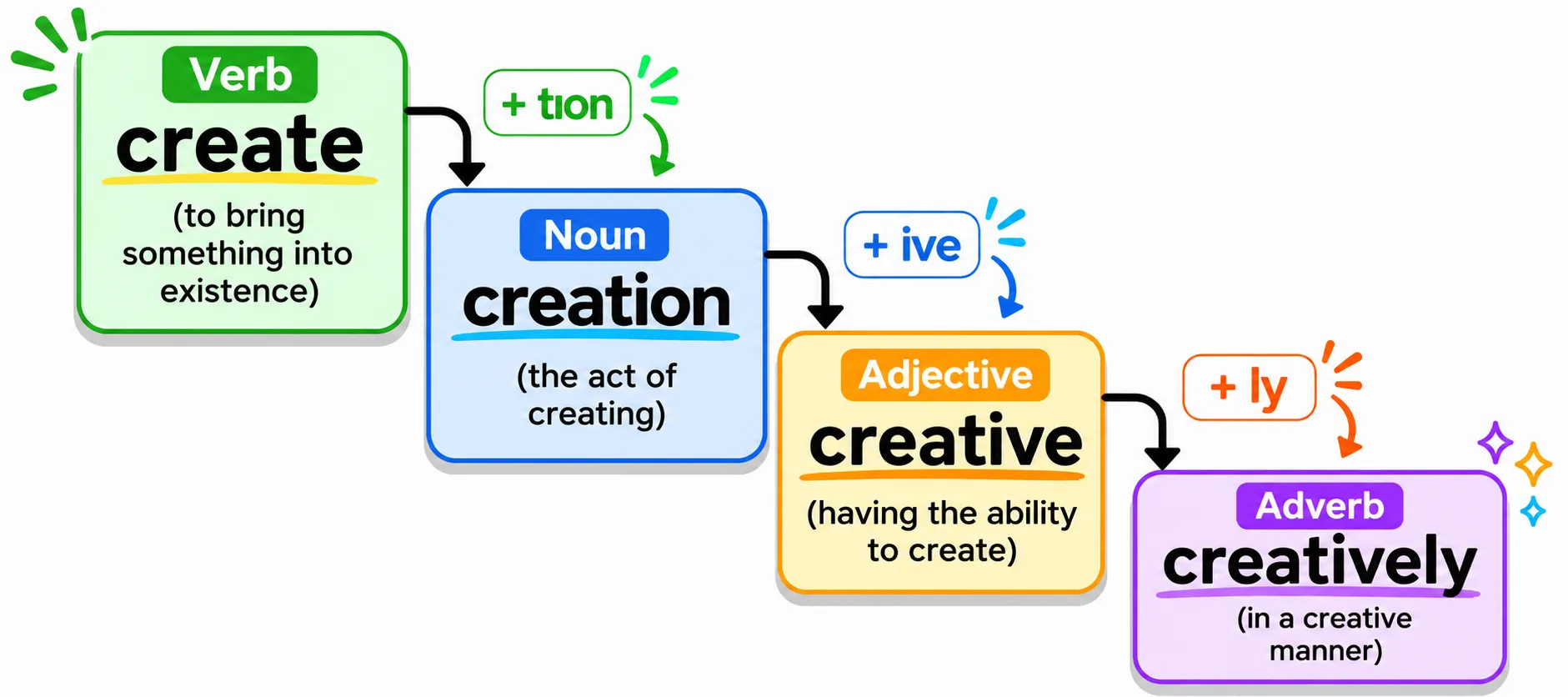
Sentence Transformations:
- Verb: She creates beautiful paintings.
- Noun: Her artistic creation was praised.
- Adjective: He is a very creative designer.
- Adverb: She solved the problem creatively.
By learning word families, your command of English vocabulary will grow four times faster!