Prefixes & Suffixes: The Foundation of English Word Formation
Have you ever encountered a long, complex English word like “unpredictability” or “decentralization” and felt overwhelmed?
The secret to mastering English vocabulary is realizing that most long words are built from smaller, simpler building blocks. By understanding how prefixes and suffixes (collectively known as affixes) attach to root words, you can unlock the meaning of thousands of new words without ever looking them up in a dictionary.
In this comprehensive guide, we will break down the mechanics of English word formation, helping you identify root words, use common prefixes, apply key suffixes, and understand the critical spelling rules that govern them.
1. What are Affixes, Roots, and Bases?
To build or dissect a word, you must understand its three primary anatomical components:
- Root Word: The absolute core of a word that contains its primary meaning. It cannot be broken down into further parts. (e.g., form, struct, port). Many roots in English come from Latin or Greek.
- Base Word: A standalone English word that can receive affixes. A base word can be a root itself, or a root that already has an affix. (e.g., happy, agree, helpful).
- Affix: A letter or group of letters attached to a root or base word to modify its meaning or change its grammatical category (part of speech).
The Two Types of Affixes
Affixes are categorized based on where they attach to the base word:
1. Prefix
- Position: Attached to the beginning of a word.
- Function: Modifies the meaning (often making it negative, indicating time, location, or degree) without changing the word class.
- Examples: unhappy, disagree, rewrite.
2. Suffix
- Position: Attached to the end of a word.
- Function: Frequently changes the grammatical category (part of speech) or indicates grammatical features (plurality, tense).
- Examples: happiness, agreement, helpful.
2. Why Study Prefixes and Suffixes?
Linguists and search engines agree: morphology is key to vocabulary acquisition. Developing a strong command of affixes provides three major advantages:
- Exponential Vocabulary Growth: Instead of memorizing happy, unhappy, happiness, and unhappiness as four separate words, you only need to learn the base word happy and how the prefix un- and suffix -ness operate.
- Part of Speech Recognition: Suffixes tell you exactly how a word functions in a sentence. For instance, any word ending in -ness or -ment is a noun, while words ending in -ize or -ify are verbs.
- Reading and Listening Comprehension: When reading or listening to advanced texts (such as academic papers, news articles, or business correspondence), you can immediately deduce the meaning of unfamiliar words by stripping away their affixes.
3. The Anatomy of a Word: A Complete Breakdown
Let’s dissect the word unpredictability to see how affixes work together in a sequence:
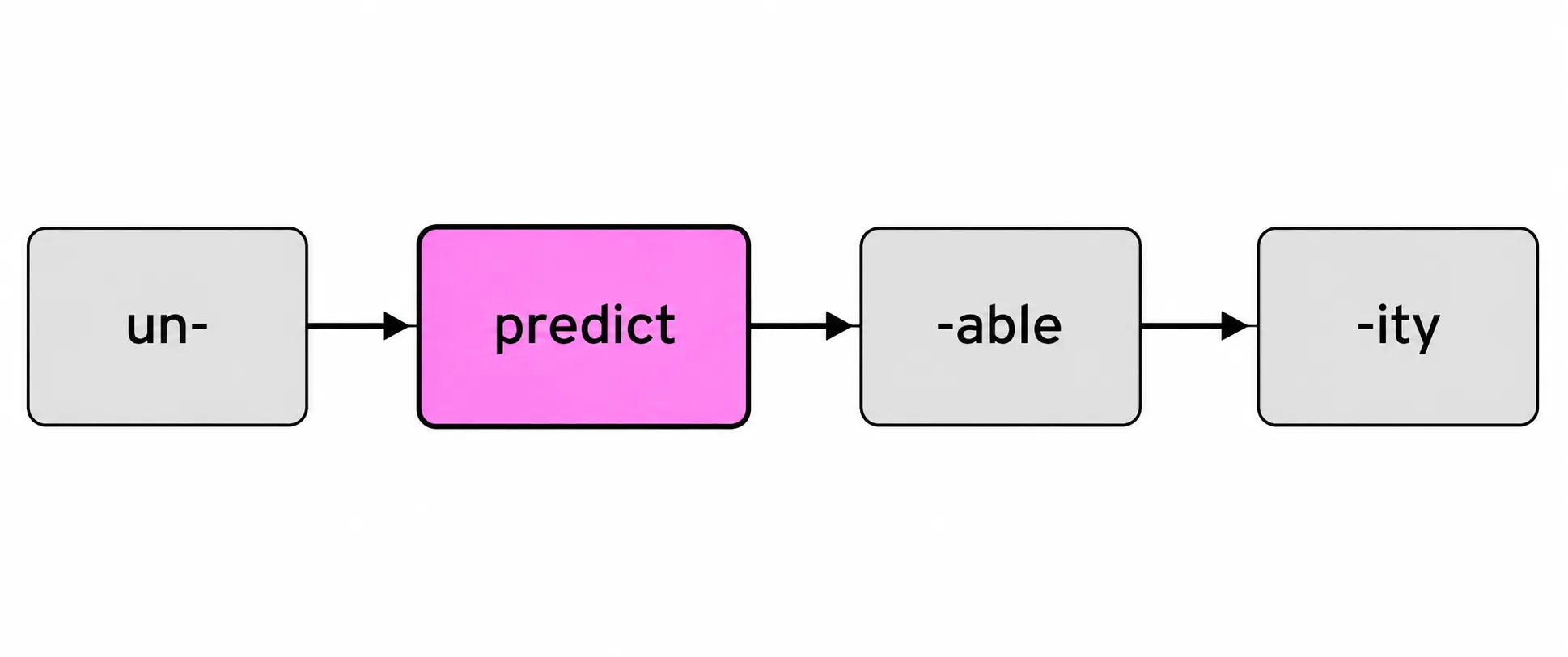
- dict (Latin Root) = to say or speak
- pre- (Prefix: before) + dict = predict (verb: to say before it happens)
- predict + -able (Suffix: capable of) = predictable (adjective: capable of being predicted)
- un- (Prefix: not) + predictable = unpredictable (adjective: not capable of being predicted)
- unpredictable + -ity (Suffix: state or quality of) = unpredictability (noun: the state of being unpredictable)
By understanding each component, you can trace a word’s structural evolution from a simple verb root to a complex abstract noun.
4. Module Map: What You Will Learn
Throughout this comprehensive module, we will explore word formation in deep detail across the following lessons:
- Introduction to Affixes: Understand the difference between inflectional and derivational affixes, and master the spelling rules when attaching them to words.
- Common Prefixes: Learn the most frequent English prefixes categorized by their meanings: negation, time, location, size, and quantity.
- Common Suffixes: Master noun-forming, verb-forming, adjective-forming, and adverb-forming suffixes, along with their semantic purposes.
Let’s begin our journey by exploring the foundational concepts of affixes in Introduction to Affixes.