Active vs. Passive Voice: The Mechanics of Voice Transformation
To confidently use the passive voice, you must master the step-by-step process of converting an active sentence into a passive one. This process involves shifting sentence elements, modifying verbs, adjusting pronouns, and understanding verb types.
1. Step-by-Step Sentence Transformation
Let’s look at the basic active structure and how it transforms:
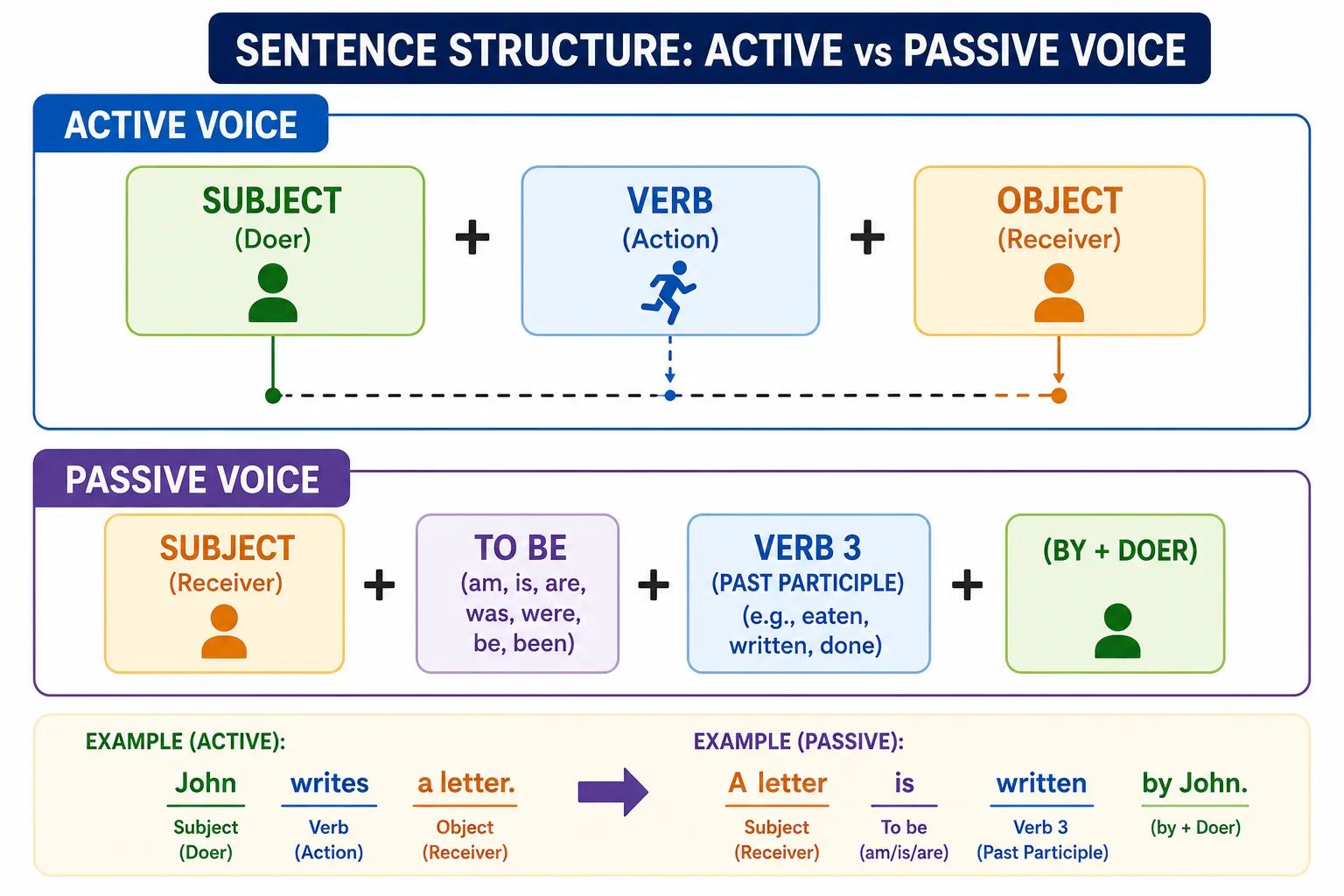
The 4 Transformation Steps:
- Identify the Subject, Verb, and Object (SVO):
- Active: The dog (S) bit (V) the postman (O).
- Move the Object to the Subject Position:
- Passive Subject: The postman…
- Change the Verb to Be + Verb 3:
- Since bit is past tense, use the past tense of be (was or were) and the past participle of bite (bitten).
- Passive Verb: …was bitten…
- Place the Performer in a “by-phrase” (Optional):
- Passive Agent: …by the dog.
- Full Passive: The postman was bitten by the dog.
2. Pronoun Shifts
When active subjects are pronouns, they must change from subject pronouns to object pronouns when placed after the preposition by in the passive voice.
| Active Subject Pronoun | Passive Object Pronoun (after by) |
|---|---|
| I | by me |
| He | by him |
| She | by her |
| We | by us |
| They | by them |
Examples:
- Active: She wrote the email.
Passive: The email was written by her. (Not: by she). - Active: They invited us.
Passive: We were invited by them.
3. Transitive vs. Intransitive Verbs
Not all sentences can be made passive! A sentence must have a transitive verb (a verb that takes an object) to have a passive form.
A. Transitive Verbs (Can Be Passive)
Verbs like write, buy, build, eat, find take a direct object.
- Active: He bought a laptop.
Passive: A laptop was bought by him. (Possible).
B. Intransitive Verbs (Cannot Be Passive)
Verbs like go, sleep, arrive, exist, happen, run do not take a direct object.
- Active: The package arrived yesterday.
- Passive: A package was arrived by… (Ungrammatical / Impossible).